The burial sites at Knobb’s Farm indicate that the Romans turned to harsh punishments to keep their British subjects in line in the third century.
Dave Webb / Cambridge Archaeological UnitOne of the beheaded skeletons found at Knobb ’s Farm .
Ancient Romans left an enduring mark on present - 24-hour interval Britain . Crumbling pit walls across the island speak to their once - vast empire . But a cemetery unveil in Cambridgeshire highlighting another bequest of Roman dominion — its ferociousness . Here , archaeologist discovered a high number of decapitated skeletons , likely belonging to people who somehow bruise their conquerers .
Archeologists from the Cambridge Archaeological Unit made the find at Knobb ’s Farm in Cambridgeshire , some 70 miles north of London . There , between 2001 and 2010 , they unearthed three Roman - epoch cemeteries from the third century .

Dave Webb/Cambridge Archaeological UnitOne of the decapitated skeletons found at Knobb’s Farm.
But these burial ground stood out . Of the 52 sepulture , 17 were decapitated , and 13 were inhume case down . And now , researchers are repoint out the significance of the macabre situation .
“ Knobb ’s Farm has an exceptionally high dimension of beheaded bodies and prostrate inhumation ( 33 percent and 25 per centum ) when compared with burial grounds locally and across Roman Britain,”noted a study publishedin the journal Britannica in May 2021 .
The people buried at Knobb ’s Farm also seemed to have died violent deaths . Isabel Lisboa , the archeologist who top the excavation , noted that they werelikely alivewhen decollate .
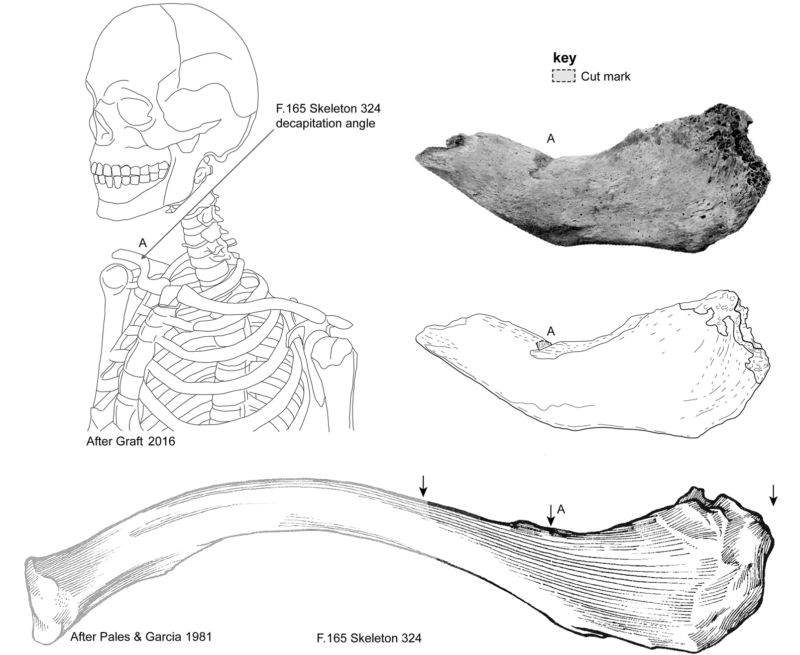
Cambridge Archeology UnitA graphic showing that this skeleton was hit with a “blow was directed obliquely downwards from behind and to the left,” indicating that he was kneeling when he died.
Cambridge Archeology UnitA graphic read that this skeleton was hit with a “ snow was manoeuvre obliquely downwards from behind and to the unexpended , ” indicating that he was kneeling when he died .
Some of the skeletons even bear marks of more utmost wildness . One man had several deep cuts in the back of his skull , suggesting that someone had subdued him with a sword before chopping off his fountainhead . And one cleaning lady ’s skeleton bore cut marks on her face , sleeve , and legs .
“ It is not potential to distinguish whether [ her injuries ] were made now before destruction ( result from , for example , agony or flaying ) or after death ( for example , from cadaver mutilation , post - mortem ‘ punishment ’ or ritual Delaware - fleshing of the body ) , ” noted the study .
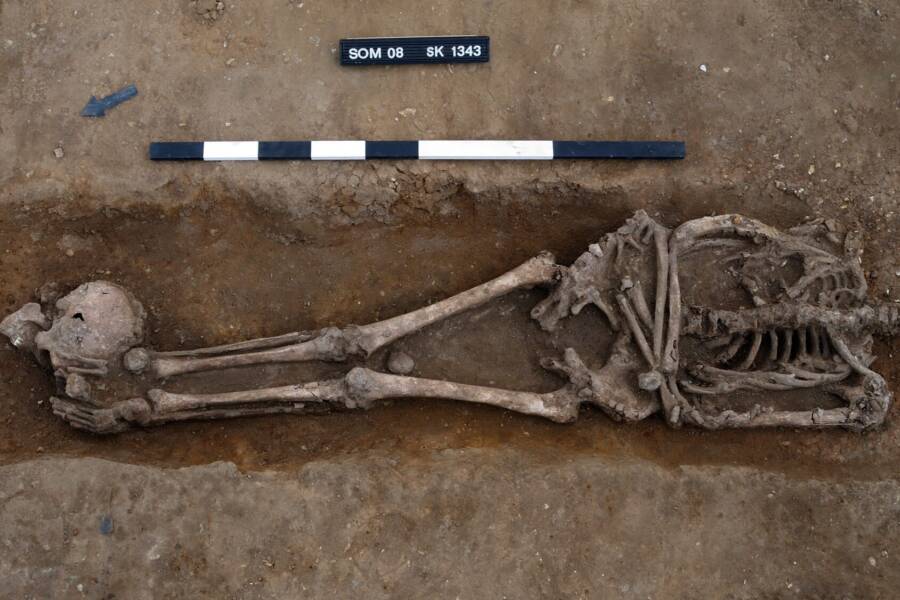
Dave Webb/Cambridge Archaeological UnitSome decapitated skeletons had their skulls placed at their feet, perhaps to keep their spirits from rising.
So why does Knobb ’s Farm comprise so many beheaded skeletons ? It likely has to do with both the age of the skeletons and their positioning .
Dave Webb / Cambridge Archaeological UnitSome decapitated frame had their skull placed at their feet , perhaps to keep their look from prove .
For 400 geezerhood — until about 410 A.D. — the Roman Empire ruled over present - day England . But their grip on power started to slip in the third 100 . As a result , anyone who dared defy the Romans could confront utmost punishment .
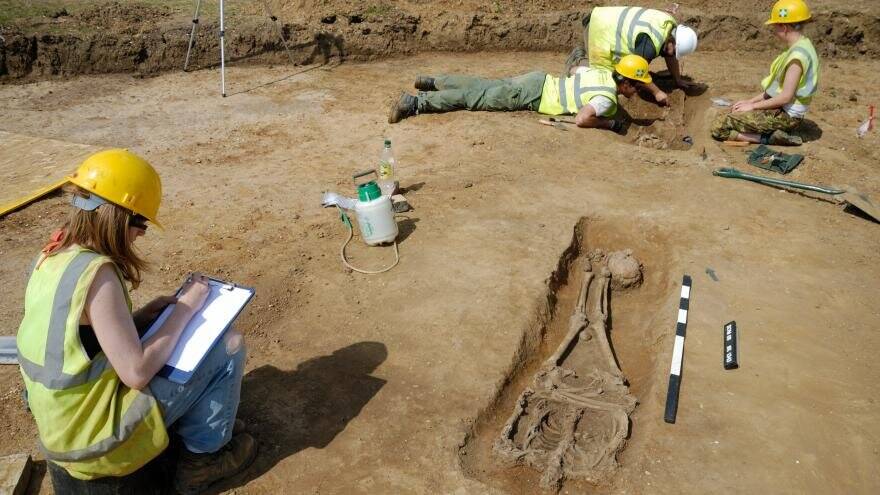
Dave Webb/Cambridge Archaeological UnitArcheologists at the burial site.
“ Any speck of insurrection against the Roman country would ’ve been dealt with extremely violently , ” explained Chris Gosden , a professor of European archeology at the University of Oxford .
Indeed , the number of crimes in Britain that Romans felt worthy of the death penaltymore than doubledin the third 100 — and quadrupled in the quaternary C .
As such , researchers also noted that Roman burying ground of the first and second century contained roughly 5 pct decapitated bodies . But cemetery that date between the third and fifth centuries contain almost 10 percent .
Dave Webb / Cambridge Archaeological UnitArcheologists at the burial site .
Plus , the people who worked at Knobb ’s Farm served a in particular authoritative purpose to the Roman Empire — they help supply the Roman Imperial Army . They bear unusual examination from bureau .
“ Roman law seem to have been applied particularly gratingly at Knobb ’s Farm because it was associated with cater the Roman army , so there were many beheading , ” explain Lisboa .
“ criminal offence commonly would have been rent go , but there were probably tensions with the Roman army . ”
Because people living in the area supply gist and grain to Roman troops , Romanist authorities harshly penalise any wrongdoing . crime that merited the death penalty , concord to Gosden , could range from murder and theft to merely desecrating a shrine .
Over the century , the flush bestow against those kill at Knobb ’s Farm have been lost . But archaeologist do have a twosome of clues about the people themselves . By studying their desoxyribonucleic acid and tooth enamel , investigator believe that Romans recruited masses from far - flung part like present - day Scotland , and the Alps .
And because they were buried among non - decapitated skeletons , investigator suspect that they had people who loved and cared for them .
“ They were not buried as Ishmael — they were inter in the normal rite with miniature jackpot around their heads , ” Lisboa note .
Indeed , despite the brutality of papistical formula in England , it seems that the Romans did allow their subjects one little mercy . papistic law permitted friends and families of carry through criminal to call for the return of their bodies , for a proper burial .
After read about the beheaded Roman - era bodies found in England , study about this Polish graveyard fortressdiscovered by an eagle - eyed archeologist . Or , see how archeologist in Tennessee reveal the world’soldest get it on tattoo acerate leaf .
