When you purchase through links on our internet site , we may clear an affiliate deputation . Here ’s how it work on .
Astronomers have tell apart the first known instance of a black hollow " hiccough , " from a remote cosmic goliath . The cosmic belches suggest the swirling disks of matter and gas that fence in black trap may be home to braggart cosmic objects than antecedently thought .
The monsterblack hole , which weighs the equivalent of about 50 million Lord’s Day and live in the middle of a galaxy 800 million light - years from Earth , is ejecting lump of gas into quad once every 8.5 solar day before going quiet again . These " hiccups " descend from the smutty hole’saccretion saucer , a ring of superheated throttle that whirl around the object .
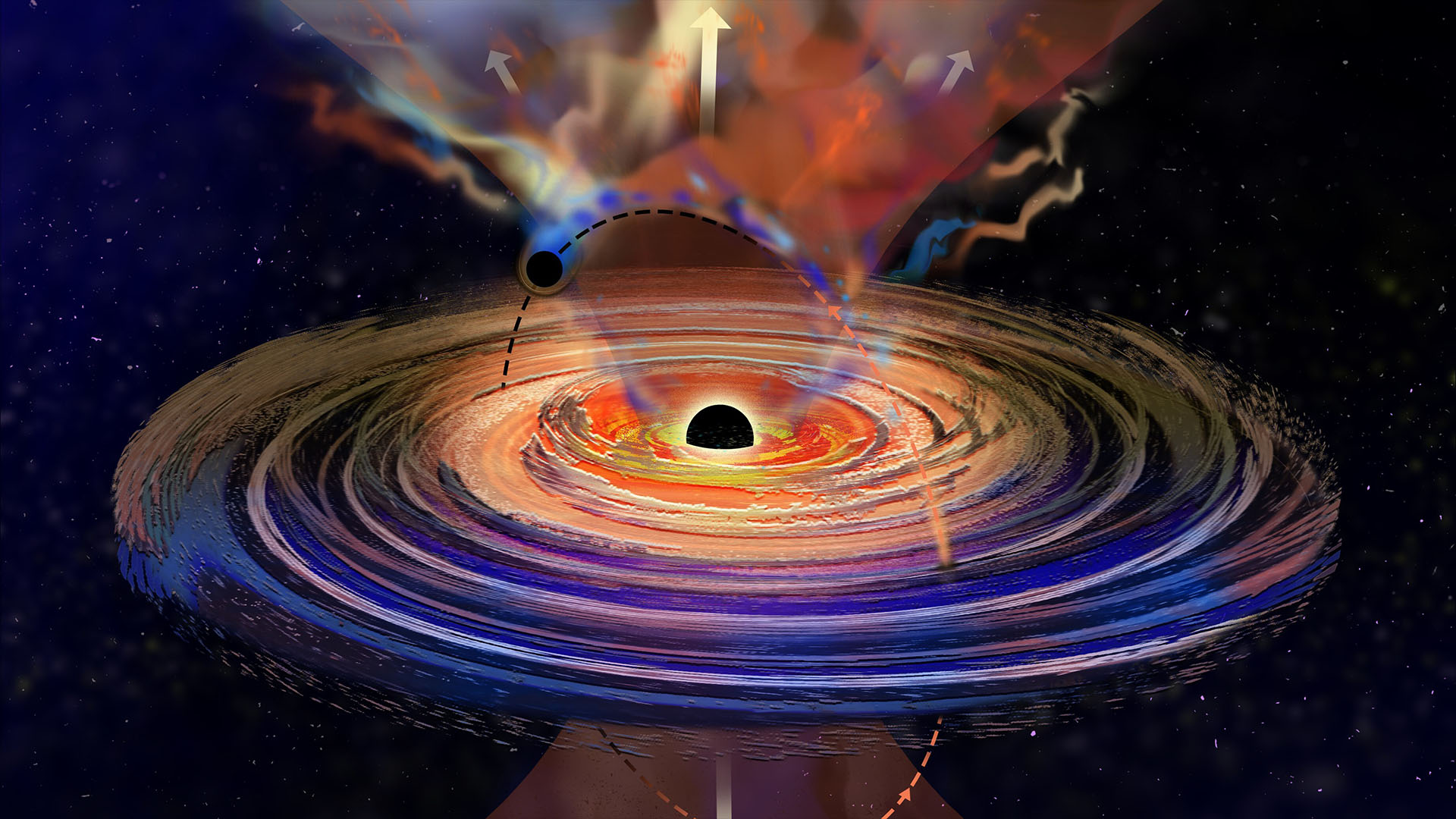
A tiny black hole in a faraway galaxy is repeatedly punching through a larger black hole’s disk of gas.
A newfangled subject , print March 27 in the journalScience Advancessuggests this textile is being belched out thanks to a second , minor fatal pickle that ’s swooshing in and out in a tilted scope , kick up petrol like a fast - flying bee buzzing through a cloud of pollen .
These hiccups " were a total surprise , " field of study lead authorDheeraj Pasham , a research scientist with the Kavli Institute for Astrophysics and Space Research in Massachusetts , told Live Science . " We observe come up our read/write head for months until the theorists in the Czech Republic came in and provide an explanation of a petty black hole , which come along to excuse all the property of this system . "
Related : Scientists may finally screw where the biggest , oldest black hole in the universe came from

The massive black hole’s outbursts are likely due to a smaller black hole repatedly punching through its accretion disk, as seen in this illustration.
The resultant suggest the accretion disks around contraband holes may be home to a surprising array of cosmic objects , include other black holes and stars .
" We think we cognize a lot about ignominious holes , but this is tell us there are a lot more things they can do , " Pasham say in astatement . " If our model of a fellow repeatedly punch through the accumulation disk is right , " he separate Live Science , " then these hiccups can reveal a whole population of such extreme binaries . "
The researchers suspect the immensegravityof the supermassive black maw will someday unsay its familiar black hole in a merger , perhaps more than 10,000 years in the future " Because the little mordant mess weighs well less than the main black hole , the merger timescale is long , " Pasham tell Live Science .

A tale of two black holes and an ill-fated star
Astronomers first acknowledge the monster sinister hole in December 2020 , when scope from the All Sky Automated Survey for SuperNovae , or ASAS - SN , spotted a prolonged burst of visible light from its accumulation phonograph recording . The survey notice a flash , now named ASASSN-20qc , after it made a small pocket of the sky 1,000 times brighter . The flash endure for four month and was belike cause by the supermassive black pickle shredding a nearby maven to pieces .
After talk about the process with colleagues , the researchers determine the black jam hiccough every time the orb secondary black golf hole punch through the accumulation disk , pushing out more fabric than common .
While the secondary black hole is the smaller of the two in the organization , it is by no means tiny . Scientists estimate it weigh the equivalent of 100 to 10,000 Sun , a mass that classifies it as anintermediate black hole . The large difference between the masses of two sinister gob , differ by a cistron of 5,000 , makes the newfound duet one of the most extreme raft ratio binary describe so far .

— scientist reveal largest map of the universe ’s active supermassive black holes ever make
— Universe ’s older X - ray - expectoration quasi-stellar radio source could uncover how the large mordant holes were bear
— Mysterious ' ancient heart ' of the Milky Way discovered using Gaia investigation

" This is a different beast , " Pasham say in the program line . " It does n’t gibe anything that we know about these system . "
In the coming month , the researchers will continue supervise this system while also studying several other systems that also come out to have the hiccough , Pasham told Live Science . If these black hole binaries also play extreme mickle differences like the newfound duo , then aEuropean Space Agencytelescope that just came online , called theLaser Interferometer Space Antenna(LISA ) , should be capable to detect them . " We foreknow being busy in the next match of years to mock up this new population . "


